Gold Plates Used for the Book of Mormon Translation
Under the Banner of HeavenThe Gold Plates Used for the Book of Mormon Translation are the sacred text that, in the book’s account, Moroni told Joseph Smith had been buried on a nearby hill for fourteen hundred years. Their significance lies not only in what they were said to contain, an account of the continent’s former inhabitants, but in the chain of instructions, failed attempts, witnesses, and interrupted translation that gathered around them. The narrative presents them as a physical object with a reported form and history, while making access to them conditional and their custody temporary.
Revelation and the First Attempt
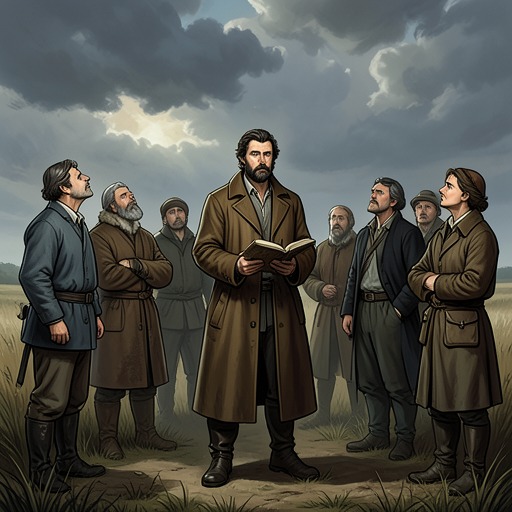
According to the account, in autumn 1823, when Joseph Smith was seventeen, an angel introduced himself as Moroni and said he had been sent by God. Moroni described a sacred text inscribed on solid gold plates, buried beneath a rock on a nearby hillside, and showed Joseph Smith the location in a vision. The instructions placed clear limits on the revelation: he was not to show the plates to anyone, profit from them, or retrieve them yet.
The next morning, Joseph Smith went to the hill, found the distinctive rock, and dug beneath it. Inside a box made from five flat stones cemented with mortar were the plates. He tried to take them despite the warning that the time had not come; they vanished, and he was thrown to the ground. Joseph Smith later understood the failed attempt as a chastening for allowing greed to overcome obedience. The episode made possession conditional: finding the object did not mean that he was entitled to remove it.
Moroni allowed another opportunity, directing Joseph Smith to return to the same place each year on September 22. At the hill later named Hill Cumorah, he received instruction about the plates and what God intended him to do with them, but left empty-handed after each visit. In 1826, Moroni told him that he might obtain them the following September if he did right. Joseph Smith also learned, by consulting his peep stone, that he was required to marry Emma Hale and bring her to the hill. He persuaded her to elope with him on January 18, 1827.
Recovery and Reported Form
Shortly after midnight on the appointed September day in 1827, Joseph Smith and Emma went to Hill Cumorah. After four earlier visits without receiving the plates, Joseph Smith dug beneath the rock again and removed the stone box. The account describes the couple’s preparations and journey as deliberate: they wore black and traveled the three miles from the Smith farm in a black carriage drawn by a black horse. This time, Moroni permitted Joseph Smith to take temporary possession of the contents.
Joseph Smith described the object as a book of gold pages, about six inches wide and eight inches long, each page no thicker than common tin. He said that engravings in Egyptian characters covered the pages and that three rings bound them into a volume about six inches high. The language was later described as reformed Egyptian. These particulars give the sacred text a reported material shape—metal pages, inscriptions, and bindings—rather than leaving it as an unspecified vision or message.
The narrative also records testimony offered in support of the plates’ physical presence. Nineteen witnesses would later testify that they had seen the book. Eight made a joint affidavit, printed in The Book of Mormon, stating that the pages appeared to be gold, that they had handled them, and that the engravings looked ancient and carefully made. The account presents this testimony as a distinct layer of evidence: the plates are first introduced through Joseph Smith’s experience, then described through his report, and also attested to by people who said they saw and touched them.
Translation and Interrupted Custody
Moroni had provided Joseph Smith with a set of interpreters, described as divinely endowed spectacles for understanding the unfamiliar writing. Using them, Joseph Smith began dictating a translation to Martin Harris, a neighbor who served as scribe. After two months, the pair had completed 116 pages. Their work paused when Moroni retrieved both the plates and the spectacles, and Joseph Smith allowed Martin Harris to borrow the manuscript to show his skeptical wife.
The manuscript disappeared. The account reports the prevailing suspicion that Martin Harris’s wife, angry about his involvement, took and destroyed the pages, while acknowledging that what happened to them was not known. Martin Harris told Joseph Smith that the translation was lost, and Joseph Smith was devastated. The missing pages threatened to leave his mission without a visible result; the object and its translation could not simply be treated as interchangeable, since the plates remained in Moroni’s custody while the completed manuscript was gone.
In September 1828, after Joseph Smith had prayed and expressed contrition, Moroni returned the plates and translation resumed. This time the spectacles were not returned with them. Joseph Smith instead used his favored chocolate-colored, egg-shaped seer stone, which he had discovered twenty-four feet underground while helping dig a well in 1822. Emma Smith first served as scribe, and others later shared the work. The change in instrument and scribe marks a new phase in the process: the plates remained central to the account, but the means of translating and the people participating in the work changed.
Custody, Material Evidence, and Significance
The plates’ appearances and disappearances structure the early history of Joseph Smith’s mission. Moroni first disclosed their location but withheld permission to retrieve them; the first attempt ended in their disappearance; annual visits prolonged the wait; and the 1827 recovery allowed only temporary possession before Moroni took them again during the translation’s first phase. Their return after the manuscript’s loss enabled work to resume, though without the interpreters. Custody is therefore not continuous ownership but a sequence governed by Moroni’s permission.
The narrative gives the object several related roles. It is the source of a sacred account, the focus of Joseph Smith’s repeated tests of obedience, the subject of his claims and the witnesses’ affidavit, and the basis for a translation whose first completed portion was lost. Its reported dimensions and construction make the claim concrete, while the repeated changes in access prevent the plates from becoming an ordinary possession in the story. The book’s account ultimately binds the object’s religious meaning to a history of restricted access, testimony, loss, and resumed work.